

CREATING A RIPPLE ABOUT POLLINATORS AND GARDENS
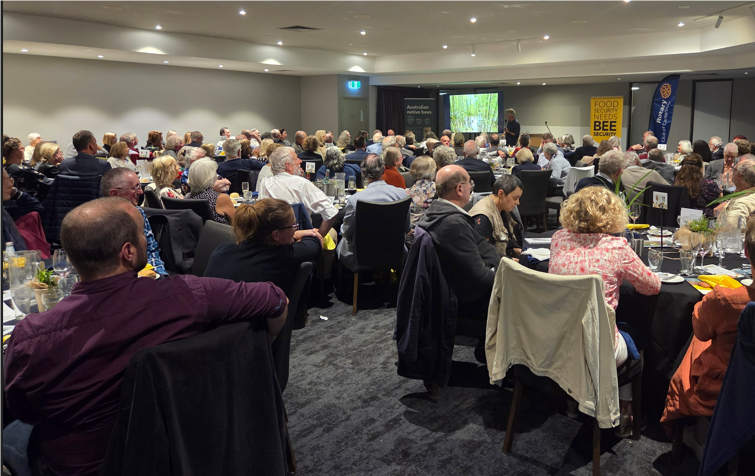
Rotarians for Bees staged a fundraiser event last Monday which provided a pot-pourri of speakers, stories and projects. The piece de resistance was, of course, Costa Georgiadis. Nonetheless, the range of topics covered at the gala function was profoundly deep.
- The first presentation was from Aris Petratos who had the unenviable task of updating the audience about the varroa mite.
- Next from the Wheen Bee Foundation was Fiona Chambers who is passionate about advocating for biodiversity and the importance of pollinators. The three prongs of her discusssion - research, awareness and connecting people - are integral to her institution. We were shown five flying insects and asked the provocative question - Which of them is a bee? The response, not surprisingly, is that there were two bees, but we were introduced to flies and wasps. Fiona wants us all, each one of us, to do something practical to encourage bee keeping. Furthermore, there is no national plan for pollination in Australia.
- One of the two separate presentations included Emma Cutting, from Heart Scapes. Her goal is to develop the Melbourne Pollinator Corridor to insects. She has managed to attain forty-six gardens, but intends to achieve two hundred altogether. The other presentation was that of Murray Wilkinson, from The Rotary Club of Balwyn, whose project consists of transforming nature strips.
- Andrew Laidlaw, landscape architect at the Royal Botanic Gardens, emphasised the intense relationship between humans and gardens. He described the Royal Botanic Gardens as the green lungs of Melbourne, which is surrounded by the CBD Heat Bank. It is an area of eighty-three acres, with a swamp which has been transformed into an ornamental lake. He stressed the importance of landscape succession planning. He also highlighted the fact that the Royal Botanic Gardens is like a piece of theatre, moving from space to mass, and then to void. The very moving description of the origins of the grotto, the spiritual connection and the sense of loss of family members who find solace in the garden, where they can slow down and find peace.
- Our very special guest from Sydney, Costa Georgiadis, praised the work of Andrew Laidlaw and described the strategies and tools which can be applied in attempting to explain the way nature works and how it affects people. We, as individuals, should be the story tellers, with a story both to tell and one to learn more about . In his words, Costa stressed that having a large goal for the whole world, we should be creating a ripple. Waves can destroy whatever is in their way, a ripple, a smaller movement, gives people an opportunity to observe and thus, learn. It is all about how people tell the story. People, thus, become the amplifier for other members of the family. We should all attempt to learn live " in nature time", which builds in a concept of patience. Furthermore, Australia is an island-continent. We should all be able to either be onboarded or making a claim, with our current documentation.
One of the highlights of the event was the presence of four school children Jacob Niven, Emily Padman, Sophia Tehranitash and Ezekiel Raebel. They are from Parkmore Primary School in Forest Hill and were accompanied by parents Michelle and Jacob Niven and Box Hill Central Environment director John Erlington and his wife Ruth.
The students represent the BEAP (Bee Education and Protection) Team which has been selected to represent Australia at the International Future Problem Solving event in the US in June. They spoke with Costa about the beginnings of their school pollinator project and with great joy about the upcoming trip to America
The students recorded a video with Costa and it may appear on his ABC Gardening program later this year. It was fantastic for all in the audience to see such enthusiasm from our junior citizens about pollinators and caring for the environment.
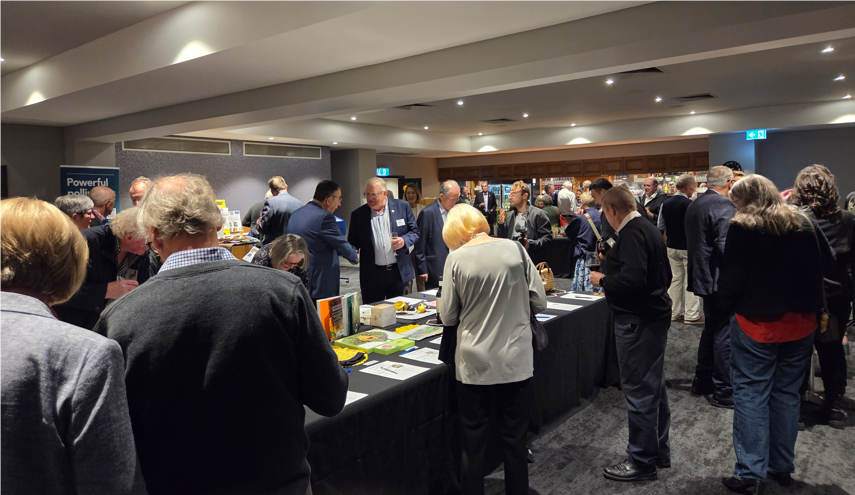
Many thanks to John McCaskill and all who contributed to the organisation of the very successful event and the audience who supported the event, the auctions, raffle and other fundraising activities.